
If you run marketing for a medical group, specialty clinic, biotech company, or healthcare brand, your problem is almost never a shortage of blog posts. Your problem is getting the right patients, referring physicians, or healthcare buyers to find your core service lines when the decision matters, and giving them immediate proof that they are in credible clinical hands.
Most agencies treat healthcare SEO and medical SEO like a volume contest. They hand you a 20-article monthly content calendar, spin up anonymous 600-word explainers about common symptoms, and wait for traffic to move.
In a Your Money or Your Life (YMYL) category, that playbook does not just waste budget. It actively erodes your authority. Google does not give anonymous medical content the benefit of the doubt, AI answer engines filter out unsourced health claims, and anxious patients bounce the second a treatment page reads like a generic template.
Using our clinical authority system, we drove +310% YTD organic traffic growth and +263% top-3 keyword rankings for [Myrtelle](/case-studies/myrtelle) (securing the #1 national ranking for "ASPA gene therapy"), and executed a 14,000-page medical supply catalog migration and indexation recovery for [Dealmed](/case-studies/dealmed). Here is how to build a healthcare SEO engine that clears Google's trust bar and fills your highest-value service lines.
Why anonymous healthcare content fails Google's YMYL bar
For years, a healthcare organization could rank a procedure page simply by matching the target keyword in the H1, writing 800 words of surface-level copy, and pointing a few directory links at the domain.
Google's Helpful Content system and Search Quality Rater Guidelines permanently raised the floor for healthcare queries. When a page can influence a person's medical care, surgical choice, or clinical procurement decision, search engines look for explicit evidence of Experience, Expertise, Authoritativeness, and Trustworthiness (E-E-A-T).
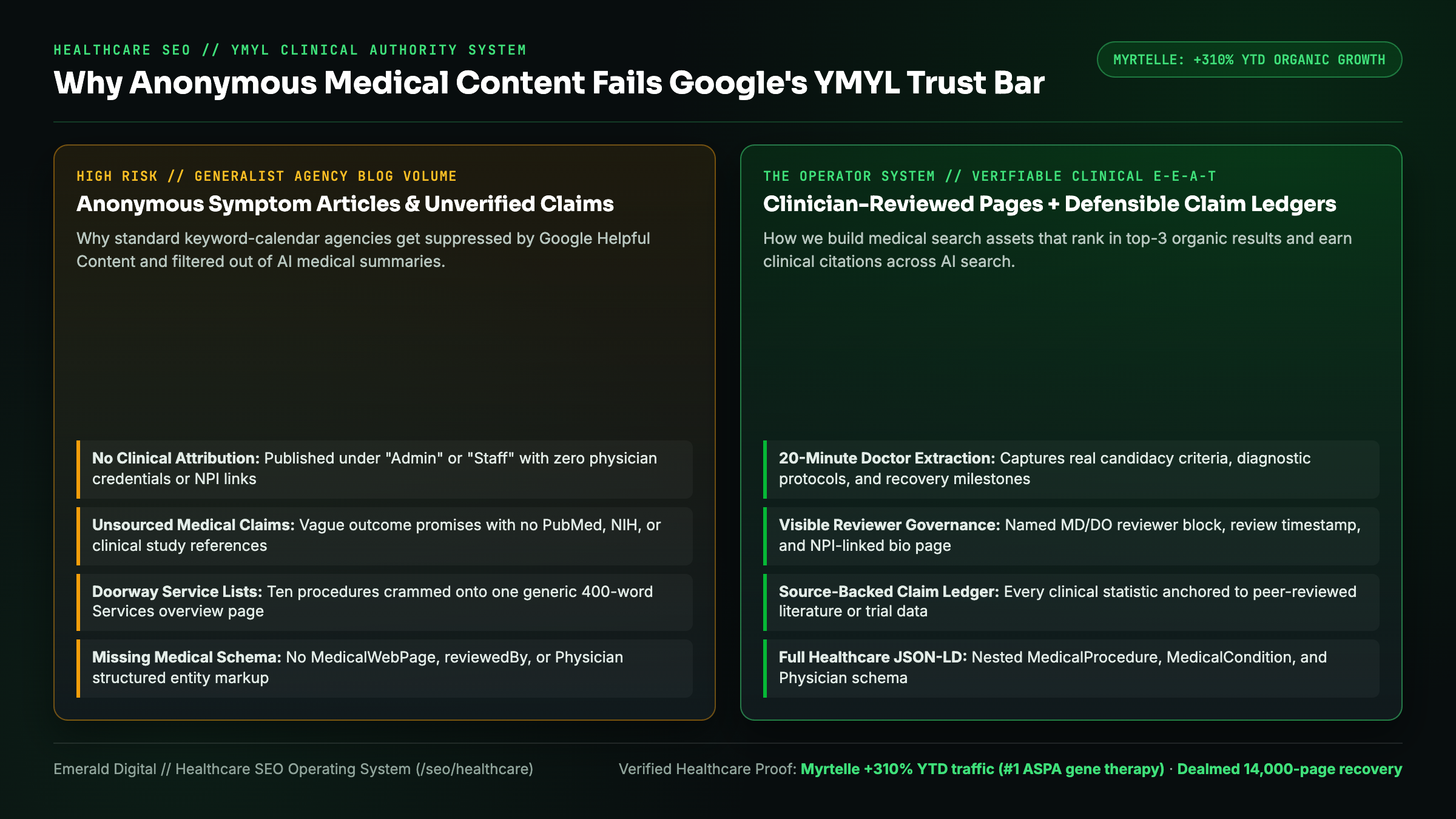
When a generalist agency publishes unreviewed articles under "Admin" or "Marketing Team," the page lacks every signal Google uses to separate clinical authorities from content farms.
| Trust Dimension | Thin Agency Activity (What Fails) | Operator Healthcare SEO Standard (What Ranks) |
|---|---|---|
| Authorship & Clinical Review | Published by "Staff Writer" or "Admin" with zero credentials or review timestamps | Named author plus a verified "Medically Reviewed by [Doctor Name, MD/DO]" block linked to a full credential bio |
| Claim Discipline & Citations | Vague promises ("fastest recovery," "painless procedure") with zero external validation | Explicit claim ledger citing peer-reviewed journals (PubMed, NIH), FDA guidance, or verified internal clinical data |
| First-Hand Clinical Experience | Rewritten Wikipedia definitions of a condition that sound identical to 500 other clinics | Real diagnostic protocols, equipment specifics, candidacy criteria, and post-procedure expectations from your clinicians |
| Structured Entity Data | Basic webpage schema or missing markup altogether | Nested MedicalWebPage, MedicalProcedure, Physician, and MedicalCondition JSON-LD with `reviewedBy` and `sameAs` NPI links |
| Conversion Path Clarity | Generic "Contact Us" form buried at the bottom of an informational post | Direct routing into appointment scheduling, insurance verification, referral intake, or clinical trial enrollment |
Build a clinical reviewer model before you scale content
Not every page on a healthcare website requires a surgeon to draft it from scratch, but every serious healthcare SEO agency operates inside a strict reviewer governance model.
Clinicians do not have time to stare at a blank Google Doc. Our editorial workflow respects physician time while capturing the exact clinical detail that search engines and patients require:
- Run a 20-minute recorded clinician extraction call. Before drafting a service-line cluster, we interview the lead specialist or medical director. We ask how they evaluate patient candidacy, which diagnostic imaging or lab panels they order first, what disqualifies a patient from a procedure, and what questions patients always ask during the consult.
- Enforce a written claim ledger. We document which therapeutic or operational claims are approved, which peer-reviewed sources back each statistic, and which compliance or HIPAA boundaries apply.
- Attach visible reviewer attribution and schema. Once the specialist signs off on the draft, we display the reviewer badge at the top of the page, record the exact medical review date, and wire the `reviewedBy` schema property directly to the physician's profile URL and National Provider Identifier (NPI) record.
- Set a 12-month clinical accuracy audit cadence. Medical standards change. Every published procedure and condition guide enters a scheduled review queue so outdated protocols never sit live on your domain.
"A patient researching a specialist on their phone at 10 p.m. can spot anonymous marketing copy in five seconds. When your page names the reviewing physician, explains how your clinic actually diagnoses the condition, and sets honest expectations for recovery, both Google and the patient trust you immediately."
Matthew Berman, founder, Emerald Digital
Map every patient and buyer search to a dedicated page
Ranking for broad medical definitions brings students and casual browsers. Filling surgical schedules, clinical trials, and B2B healthcare pipelines requires mapping search demand across four distinct page layers.
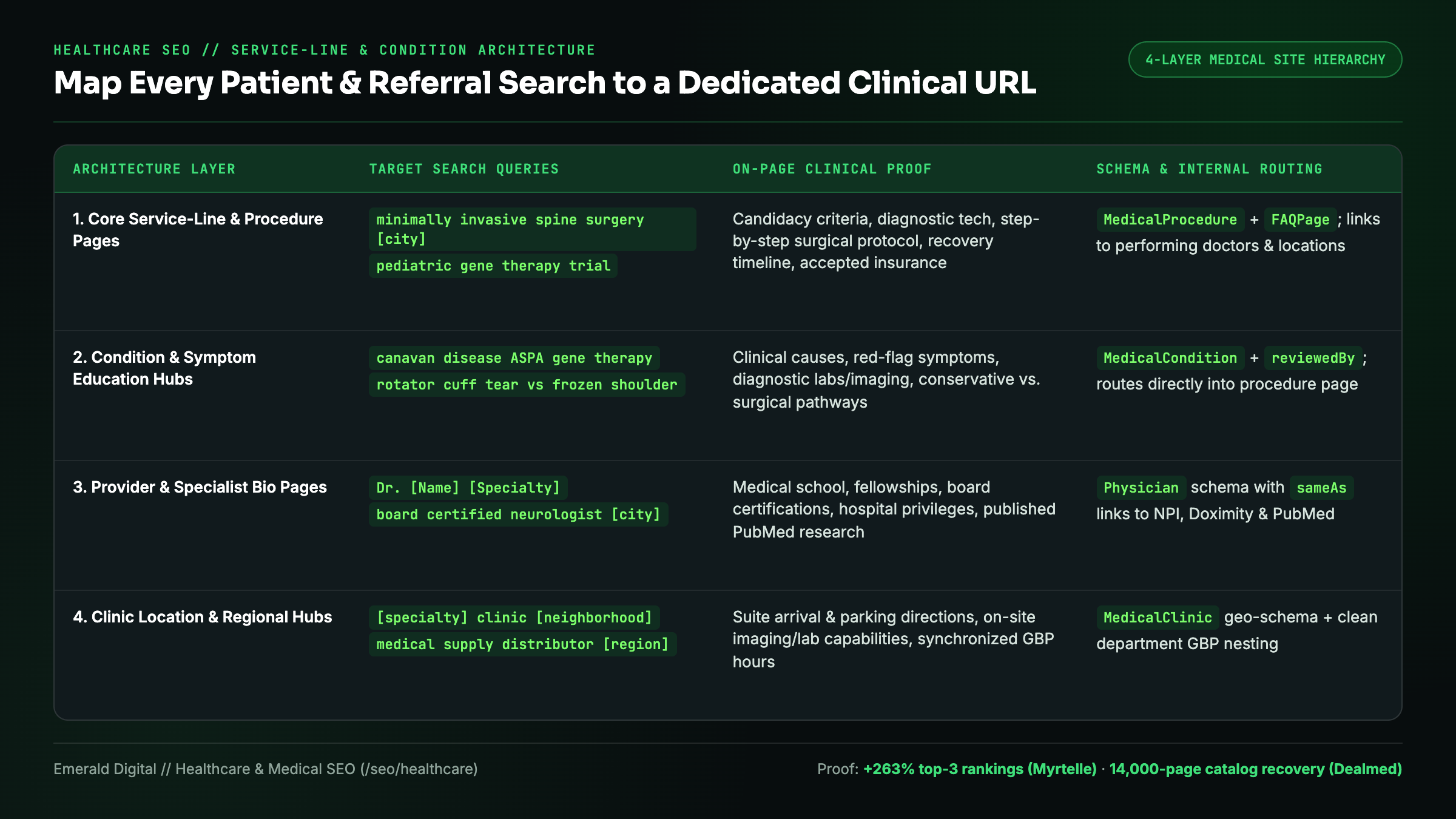
If your website lumps ten treatments onto a single "Our Services" overview or hides your doctors on a single team grid, you give Google no specific URL to rank when a patient searches for a procedure by name.
| Architecture Layer | Target Search Queries | Page Job & Content Requirements | Required Schema & Internal Link Wiring |
|---|---|---|---|
| 1. Core Service-Line & Procedure Pages | "minimally invasive spine surgery [city]", "pediatric gene therapy trial", "orthopedic urgent care near me" | Convert ready-to-book patients; cover candidacy, clinical protocol, diagnostic tech, recovery timeline, and accepted insurance | MedicalProcedure + FAQPage; links to performing physicians and clinic locations |
| 2. Condition & Symptom Education Hubs | "canavan disease ASPA gene therapy", "rotator cuff tear vs frozen shoulder", "when to see a vascular specialist" | Capture mid-funnel research; explain clinical causes, red-flag symptoms, diagnostic steps, and conservative vs. surgical options | MedicalCondition + MedicalWebPage (`reviewedBy`); links directly into the matching treatment page |
| 3. Individual Provider & Specialist Bios | "Dr. [Name] [Specialty]", "board certified neurologist [city]" | Prove E-E-A-T for both patients and Google; list medical school, residency, fellowships, board certifications, hospital affiliations, and published research | Physician schema with `medicalSpecialty`, `alumniOf`, and `sameAs` links to NPI, Doximity, and PubMed |
| 4. Location & Regional Access Hubs | "[specialty] clinic in [neighborhood]", "medical supply distributor [region]" | Win Google Map Pack and local organic clicks; show exact suite arrival instructions, parking, hours, and specific treatments offered on site | MedicalClinic or MedicalOrganization with geo-coordinates, department nesting, and synchronized GBP URLs |
Proof in the numbers: Myrtelle and Dealmed
Healthcare search systems fail when agencies treat B2B medical suppliers, biotech pioneers, and multi-location clinics as interchangeable. The architecture must match how your buyers and patients actually search:
- Biotech & Clinical Authority ([Myrtelle](/case-studies/myrtelle)): For clinical-stage gene therapy company Myrtelle, families, clinicians, and researchers needed authoritative, scientifically rigorous answers around Canavan disease and ASPA gene therapy. By restructuring their clinical content architecture, tightening technical indexation, and building source-backed educational hubs, we delivered +310% YTD organic traffic growth, a +263% increase in top-3 keyword rankings, and the #1 organic ranking for "ASPA gene therapy."
- Enterprise Healthcare Catalog Scale ([Dealmed](/case-studies/dealmed)): When national medical supply leader Dealmed faced severe indexation bottlenecks across a massive product catalog, blog posts were not the answer. We executed a 14,000-page catalog migration and technical SEO overhaul, resolving duplicate facet paths, rebuilding category hierarchy, and restoring crawl efficiency across their entire commercial inventory.
Whether you need to rank clinical condition pages in Google and AI Overviews (see our guide to healthcare AI search optimization) or clean up technical indexation across thousands of SKUs, the work starts with structural clarity and verifiable proof.
The 6-point audit before you hire a healthcare SEO agency
Before you sign a retainer with any healthcare SEO agency, ask them to walk you through these six operational checks on your live site:
- Strike Zone service-line audit: Which high-margin treatment, diagnostic, or product pages currently rank between positions 5 and 20 in Google Search Console, and what specific clinical depth is missing from those URLs?
- Reviewer attribution & E-E-A-T gap check: Do your existing condition and procedure pages display a named clinical reviewer, review date, and verifiable physician bio with `Physician` and `reviewedBy` schema?
- Google Business Profile & practitioner hygiene: In multi-provider clinics, are department categories, insurance attributes, and individual doctor GBP profiles structured so they reinforce your primary clinic listing instead of cannibalizing it?
- Technical indexation & crawl budget: Are faceted directories, legacy PDFs, duplicate location tags, or parameter URLs trapping Googlebot away from your core service lines?
- AI search & citation readiness: When a patient or healthcare buyer asks ChatGPT, Perplexity, or Google AI Overviews about your specialty, are your definitions and clinical claims structured cleanly enough to be cited? Read our breakdown of AEO vs. SEO to see how retrieval and citation work together.
- HIPAA-safe conversion tracking: How is the agency measuring organic phone calls, booked consultations, and referral forms without leaking protected health information into third-party ad pixels?
Our healthcare SEO retainers start at $3,500/month for focused single-location practices and $5,000 to $10,000/month for multi-location medical groups, specialty centers, and healthcare brands, powered by our open-source agentic search engine (the seo-kit on GitHub).
Explore our healthcare SEO services, review our broader SEO system, or request a free clinical search teardown. We will audit your current service-line rankings, E-E-A-T signals, and competitor gaps and show you the exact roadmap to own your category.