Few things frustrate an established business owner more than typing `who is the best [service] in [city]` into ChatGPT, Perplexity, or Google AI Overviews and watching the model recommend a smaller, younger competitor that you beat in the real world every week.
It feels arbitrary until you look at how answer engines actually assemble a recommendation.
AI models do not walk into your office, inspect your work, or know that you have been in business for twenty years unless that proof is structured across the web where their retrieval engines look. When ChatGPT or Google AI recommends your competitor instead of you, it is because your competitor gave the system a cleaner chain of verifiable evidence across five specific surfaces.
Here is how to diagnose the exact gap in twenty minutes and how we flip the recommendation in your favor.
How AI Decides Which Business to Recommend
When someone asks an AI engine for a vendor, law firm, contractor, or software recommendation, the system is trying to minimize the risk of hallucinating a bad answer. To do that, it looks for entity consensus plus live retrieval proof:
- Live search retrieval: When the prompt has local or commercial intent, the engine runs background searches (via Bing, Google, or its own search index) for the category, location, and qualifier terms in the prompt. If your site does not rank on page one for the underlying search query, your pages rarely enter the context window at all.
- Third-party corroboration: The model checks whether independent sources (industry directories, review platforms, local news, trade publications, Reddit, and comparison lists) repeat the same facts about who you are, what you specialize in, and who your clients are.
- On-page specificity: Finally, the model extracts specific proof points from the retrieved pages to justify its recommendation: named specialties, pricing transparency, review counts, credentials, and case outcomes.
If your website hides behind vague agency-speak while your competitor has a dedicated page for the exact specialty, 120 detailed Google reviews mentioning that service by name, and placements on four industry roundups, the model will recommend your competitor every single time. And even if the model drops your name in passing without linking to you, remember that getting mentioned in AI search is not the same as getting cited.
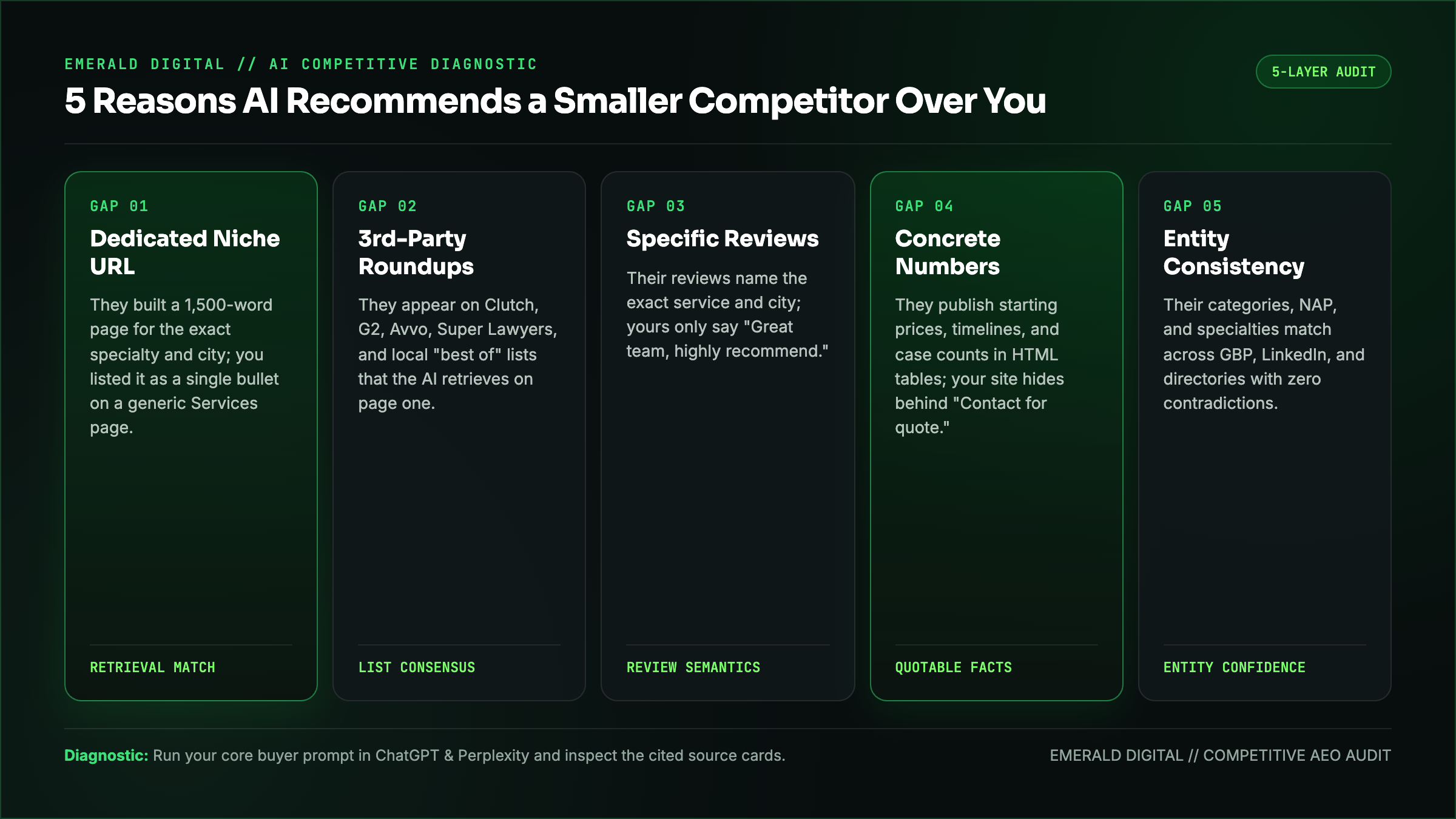
The 5 Reasons Your Competitor Is Getting the Nod
Run the exact buyer prompt where your competitor beats you and check which of these five gaps is doing the damage.
1. They Have a Dedicated Page for the Exact Specialty (and You Have a Catch-All Bullet Point)
When a buyer asks `who is the best commercial litigation firm for construction disputes in Houston` or `best Shopify SEO agency for food brands`, the model looks for a page that matches both the service and the specific niche or location.
If your competitor built a 1,500-word page dedicated to construction litigation in Houston, complete with local court experience and representative cases, while your site only mentions "construction disputes" as the seventh bullet point on a generic "Business Law" page, their page wins the retrieval match by a mile.
2. Independent Third-Party Lists Name Them and Skip You
Look at the source links attached to the AI's answer. In local and B2B categories, a huge percentage of AI citations come from third-party listicles, directories, and trade sites: Clutch, G2, Avvo, Super Lawyers, Justia, Chambers, local business journals, and niche "best of" roundups.
If your competitor appears on five of the eight external pages the AI retrieved for that query and your company appears on zero, the model concludes your competitor is the consensus market leader.
3. Their Reviews Describe the Exact Job, Not Just "Great Service"
Answer engines read review text and review summaries to verify what a business actually does well. Twenty reviews that say *"Great team, highly recommend"* give an AI model zero semantic context. Fifty reviews that say *"Helped our family navigate a contested probate estate in Orleans Parish"* or *"Rebuilt our Shopify collection architecture and doubled organic revenue"* tell the model exactly which prompts that business deserves to win.
4. Their Pages State Clear Numbers, Pricing, and Process Up Front
AI models love structured facts they can summarize into a comparison bullet:
- "Starts at $3,500/month for scoped local builds"
- "24/7 live intake with same-day site inspection"
- "Over 5,800 client contacts generated"
- "Licensed in Louisiana, Texas, and Mississippi"
When your competitor publishes clear numbers, timelines, and qualifications in plain HTML tables and bullet lists, the model has ready-made evidence to justify recommending them. When your site says "Contact us for a custom quote," the model has nothing concrete to repeat.
5. Your Entity Signals Contradict Each Other Across the Web
If your website calls you a "full-service digital consultancy," your Google Business Profile categorizes you as a "Website designer," your LinkedIn page says "Brand strategy studio," and your directory profiles still list an office address you moved out of three years ago, you dilute your entity confidence score. Models reward businesses whose name, categories, locations, and core specialties read identically everywhere.
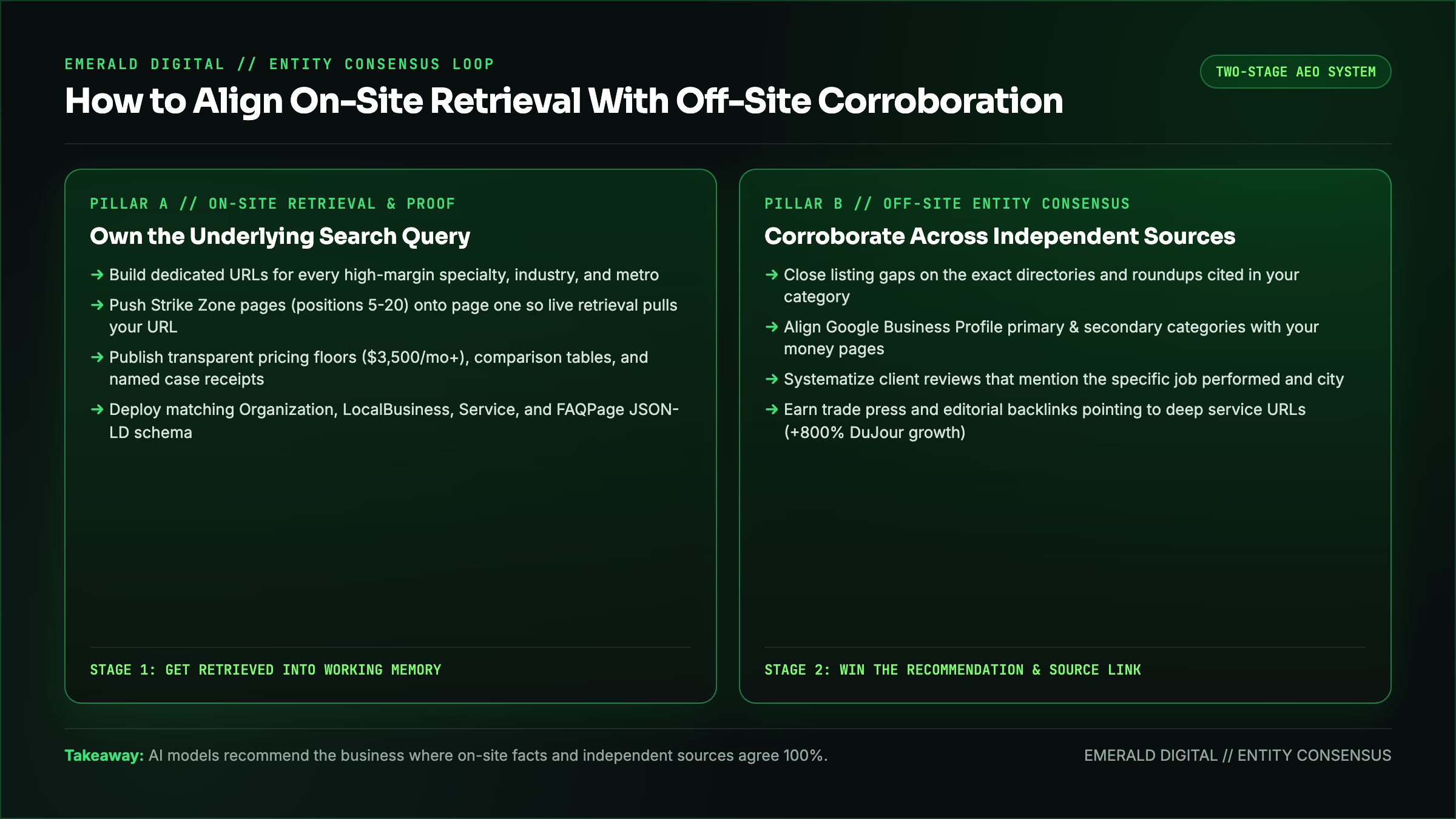
How to Take the Recommendation Spot Back
You do not fix an AI visibility gap by stuffing "ChatGPT" into your meta tags. You fix it by building stronger retrieval pages on your site and closing the third-party consensus gap off your site.
| Action Step | What to Change on Your Website | What to Change Off Your Website |
|---|---|---|
| :--- | :--- | :--- |
| 1. Match the Prompt Intent | Build dedicated pages for your highest-margin specialties, industries, and cities instead of lumping everything onto one services page | Add those exact secondary categories and service entries to your Google Business Profile and industry directories |
| 2. Upgrade Proof Density | Add specific pricing context, step-by-step methodology, credential badges, and named case outcomes in clean HTML tables | Publish original case breakdowns and data pieces that trade publications and industry blogs cite |
| 3. Close the Directory & List Gap | Publish your own honest, structured buyer's guide and comparison tables on your domain | Get listed and updated on the exact third-party directories and industry roundups the AI currently cites for your category |
| 4. Systematize Specific Reviews | Embed service-specific client testimonials and verified outcomes directly on the matching service page | Ask happy clients to mention the specific service or case type and city in their Google and industry reviews |
When we build organic and AI search programs for clients, we execute both halves of that equation simultaneously. For DuJour, pairing technical restructuring with high-authority editorial placements drove an +800% increase in organic traffic in nine months. For The Law Center, building dedicated practice-area authority from scratch took a brand-new domain to #2 nationally in six months and generated 5,800+ contacts. Those are the exact organic retrieval and authority signals that modern AI engines rely on when deciding who to recommend.
Want Us to Audit Why AI Is Naming Your Competitor?
Stop guessing why ChatGPT or Google AI favors another firm in your market. Our focused SEO and AI search programs start at $3,500/month for scoped engagements, with comprehensive multi-market campaigns typically running $5,000 to $10,000/month.
Read how our two-stage system works on our AI Search & AEO page, or request a free AI recommendation teardown. We will run your highest-value buyer prompts, show you the exact URLs and third-party sources feeding your competitor's recommendation, and hand you the step-by-step plan to overtake them.