
Every marketing agency on the internet added AEO, GEO, or AI search optimization services to their navigation menu this year. Most of them changed the title on their pitch deck and kept the exact same deliverable list from 2021: four generic blog posts a month and an automated technical audit report.
Meanwhile, the way high-intent buyers evaluate vendors has fundamentally shifted. When a founder, general counsel, or VP of Marketing asks ChatGPT, Perplexity, or Google AI Overviews *"Who are the best agencies for [category]?"* or *"How does [Your Brand] compare to [Competitor]?"*, the engine synthesizes a shortlist of two or three companies and explains why to trust them.
If your brand is left out of that synthesis, or described in flat, interchangeable language, you lose the deal before the buyer ever opens a browser tab.
At Emerald Digital, we have been building human-led AI and search systems since 2020, driving results like #2 national rankings and 5,800+ contacts for [The Law Center](/case-studies/the-law-center), +310% YTD organic growth for [Myrtelle](/case-studies/myrtelle), and +800% organic traffic growth for DuJour. Here is the operator checklist for evaluating AI search optimization services so you buy real engineering instead of a buzzword.
How to vet AI search optimization services: hype vs. engineering
To buy AI search work intelligently, you only need to understand one mechanical truth: live answer engines like Google AI Overviews, ChatGPT Search, and Perplexity use retrieval-augmented generation (RAG). First, they query a search index to retrieve a small set of candidate web pages. Second, they synthesize an answer from the pages that state verifiable facts, comparisons, and entity credentials most clearly. We explain the full technical relationship in our guide to AEO vs. SEO and our playbook on Generative Engine Optimization (GEO).
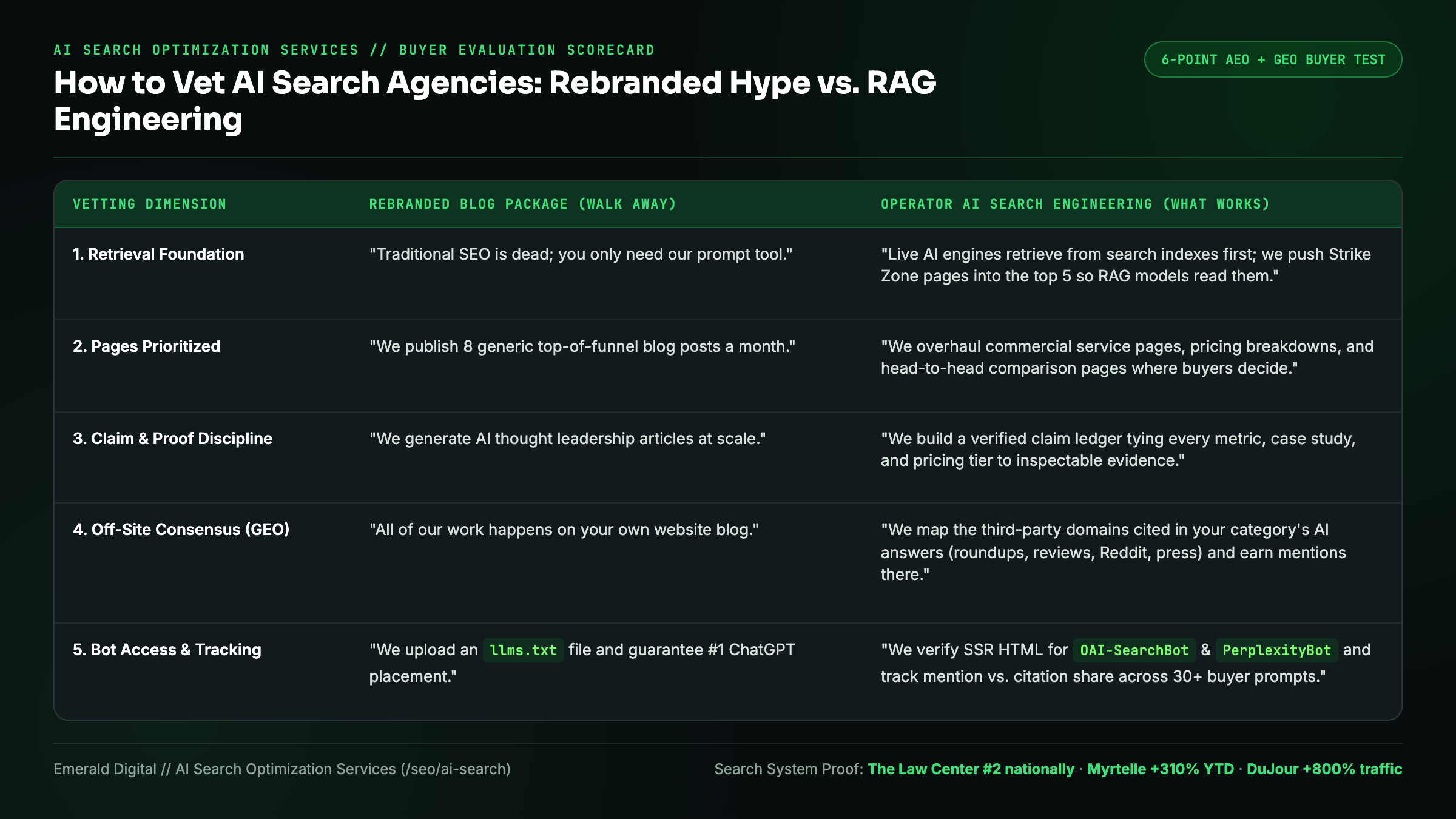
When an agency pitches you AI search optimization services, score their proposal against these six tests:
| Evaluation Test | The Rebranded Hype Pitch (Walk Away) | The Operator Engineering Standard (What Works) |
|---|---|---|
| 1. Retrieval Foundation | "Traditional SEO is dead; you only need our proprietary GEO prompt software now." | "RAG models retrieve from top organic search results first; we upgrade your Strike Zone pages into the top 5 so AI engines actually read your URLs." |
| 2. Page Types Prioritized | "We will publish 8 top-of-funnel educational blog posts a month to feed the LLMs." | "We overhaul your core money pages, pricing breakdowns, and head-to-head comparison pages where commercial buying prompts pull their answers." |
| 3. Claim & Proof Discipline | "We use AI writers to generate long-form thought leadership at scale." | "We build a verified claim ledger tying every metric, case study, and pricing tier to a source that both human buyers and answer engines can check." |
| 4. Off-Site Consensus (GEO) | "Everything happens on your blog; we do not touch external sites or reviews." | "We map the third-party domains cited for your category prompts (editorial roundups, review sites, Reddit, industry press) and earn mentions there." |
| 5. Technical & Bot Access | "We generate an `llms.txt` file and call the technical setup finished." | "We verify server-side HTML rendering, clean `Organization` / `Service` / `FAQPage` JSON-LD schema, and ensure `OAI-SearchBot`, `PerplexityBot`, and `Googlebot` have unobstructed crawl access." |
| 6. Measurement & Promises | "We guarantee #1 placement in ChatGPT within 30 days." | "We track a fixed cohort of 25 to 50 commercial buyer prompts across AI Overviews, ChatGPT, and Perplexity monthly, measuring mention vs. citation lift alongside organic pipeline." |
The 4 deliverable layers you are actually paying for
If you are signing a monthly retainer for AI search optimization services, you should know exactly what the team is building each week. Real visibility in AI answers requires work across four connected layers.
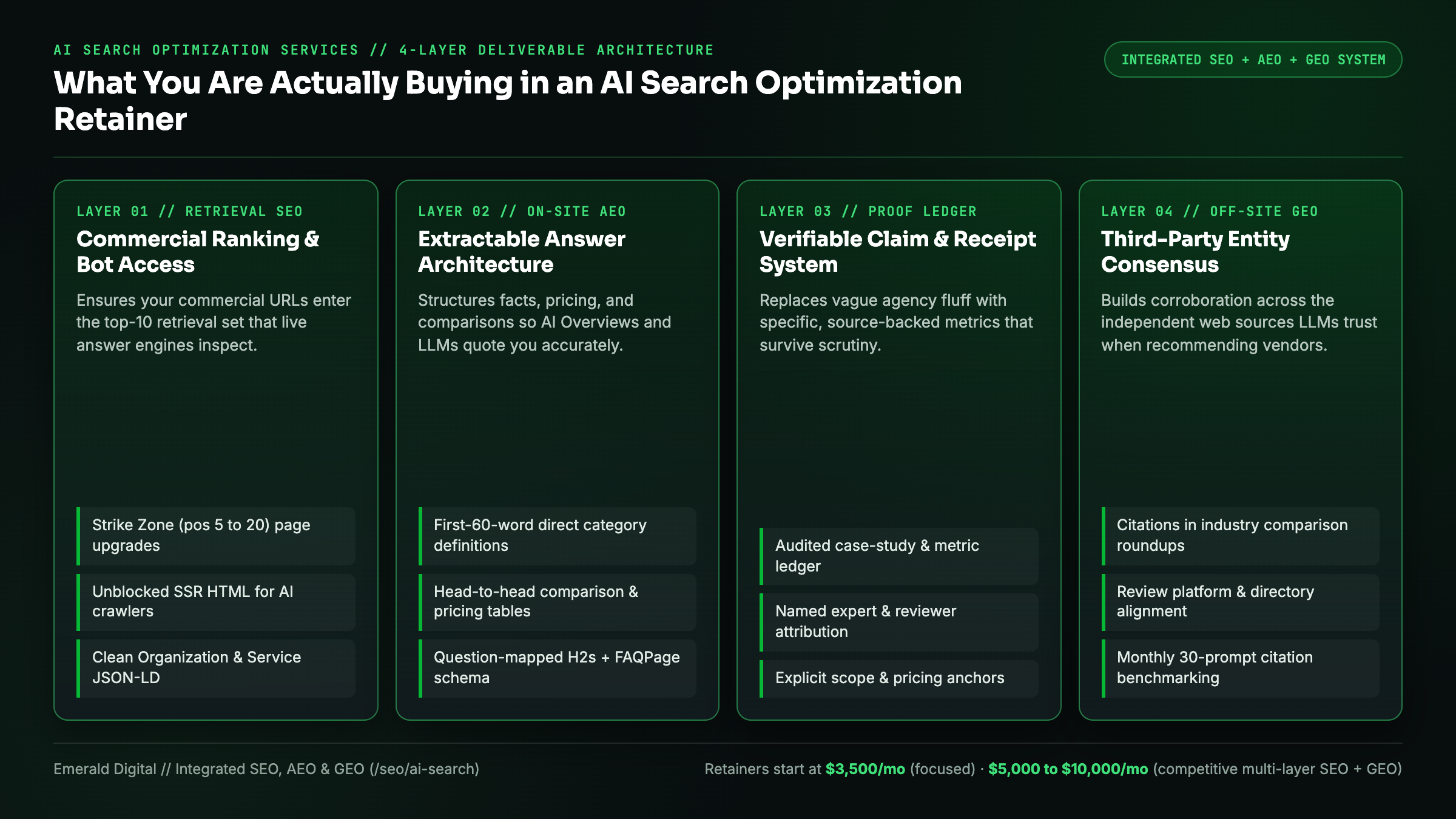
Layer 1: Entity clarity and commercial page architecture
If your homepage and service pages describe your company as an *"innovative end-to-end growth partner delivering scalable solutions,"* neither a human buyer nor a large language model can tell what you actually sell. The first job is stripping vague agency jargon out of your core service pages and replacing it with explicit entity statements: who you serve, what specific problem you solve, what your methodology is called, what it costs, and which proof receipts back it up.
Layer 2: Extractable answer blocks and comparison tables (AEO)
When a buyer asks an AI engine to compare options or explain cost drivers, the model looks for structured, high-density information it can extract cleanly without guessing. Your service should turn buried prose into first-60-word direct definitions, structured comparison tables, transparent pricing anchors, and objection-handling FAQs wrapped in valid schema markup.
Layer 3: Off-site third-party corroboration (GEO)
A brand that only praises itself on its own domain rarely wins open-ended category prompts like *"best [category] companies."* As we detail in our breakdown of why AI recommends your competitor, LLMs cross-reference your site against independent third-party sources. Your agency must audit the exact external URLs that ChatGPT and Perplexity cite for your target prompts and run a systematic campaign to get your brand included in those industry roundups, comparison directories, review platforms, and expert discussions.
Layer 4: Moving from passive mention to attributed citation
Getting named in passing inside an AI paragraph is only half the win; earning the clickable source link drives high-intent referral traffic straight to your site. Read our guide on being mentioned vs. cited in AI search to see how original data tables, named frameworks, and verifiable case-study ledgers turn your pages into the primary cited source.
"Anyone selling a secret backdoor into ChatGPT is selling snake oil. AI search engines cite the brands that rank in the retrieval window, state their pricing and methodology in plain English, back every claim with receipts, and show up across independent third-party sources."
Matthew Berman, founder, Emerald Digital
What a 90-day AI search optimization sprint looks like
Hold any prospective agency to a clear 90-day implementation schedule that connects technical access, on-site commercial upgrades, and off-site consensus:
| Phase | Core Engineering & Content Deliverables | What Changes for Your Brand in Search |
|---|---|---|
| Days 1 to 30: Baseline Audit & Entity Cleanup | Audit 30 commercial buyer prompts across Google AI Overviews, ChatGPT Search, and Perplexity; verify crawler access (`Googlebot`, `OAI-SearchBot`, `PerplexityBot`) and SSR rendering; deploy clean `Organization`, `Service`, and `Person` schema; build the verified claim ledger | Eliminates technical blind spots and establishes a clear, consistent entity footprint across your core commercial URLs |
| Days 31 to 60: Strike Zone & Comparison Buildout | Upgrade top Strike Zone commercial pages (positions 5 to 20 in GSC) with direct answer blocks, comparison tables, and transparent pricing context; publish 4 to 6 high-intent buyer comparison and evaluation guides | Pushes commercial pages into top-5 organic retrieval positions and gives AI Overviews and LLMs structured tables to extract and cite |
| Days 61 to 90: Off-Site Consensus & Citation Loop | Execute targeted outreach, digital PR, and review-platform alignment across the third-party domains cited in your category's AI answers; re-run the 30-prompt benchmark to measure mention and citation share | Increases brand inclusion in third-party roundups and lifts attributed citations and referral conversions from AI search |
Red flags that should stop you from signing
Walk away immediately if an AI search proposal includes any of these three patterns:
- Automated mass-page generation: Using cheap LLM workflows to dump hundreds of unreviewed, cookie-cutter articles onto your domain will trigger Google's sitewide Helpful Content demotions and destroy the retrieval rankings your AI visibility depends on.
- Proprietary "AI score" dashboards detached from pipeline: Vanity visibility scores across 500 zero-intent trivia prompts mean nothing if your brand is missing from the 20 commercial prompts actual buyers ask before booking a sales call.
- Zero access to senior operators: AI search requires editorial judgment, positioning clarity, and technical SEO precision. At Emerald Digital, senior operators run our open-source agentic search toolkit (the seo-kit on GitHub) to accelerate research and diagnostics while keeping human strategy and accountability at the center.
Our integrated SEO and AI search optimization retainers start at $3,500/month for focused single-category brands and $5,000 to $10,000/month for competitive B2B, healthcare, legal, and multi-category ecommerce companies.
See our AI search optimization approach, explore our broader SEO system, or request a free AI visibility teardown. We will run your core buyer prompts across Google AI Overviews, ChatGPT, and Perplexity, show you exactly why competitors are getting cited today, and map the 90-day plan to own the answer.