It's the most frustrating meeting in legal marketing. Your SEO agency hops on a Zoom call, shares their screen, and points to a green line going up and to the right. Organic sessions are up 140%. Impressions are at an all-time high.
Then you hang up, look at your case management software, and realize you signed the exact same number of retainers last month as you did a year ago.
When traffic goes up and signed cases stay flat, your agency will usually blame your intake team, and your intake team will blame the lead quality. Having audited and rebuilt acquisition funnels for firms ranging from [The Law Center](/case-studies/the-law-center) (a 7-firm national consortium) to Wilk Auslander, Cain Law Firm, The Russo Firm, Duncan Levin PLLC, and Egenberg Trial Lawyers, I can tell you it's almost always one of five specific leaks.
And you don't need a six-month consulting engagement to find out which one is bleeding you dry. You can catch it in 30 minutes using Google Search Console and your call logs.
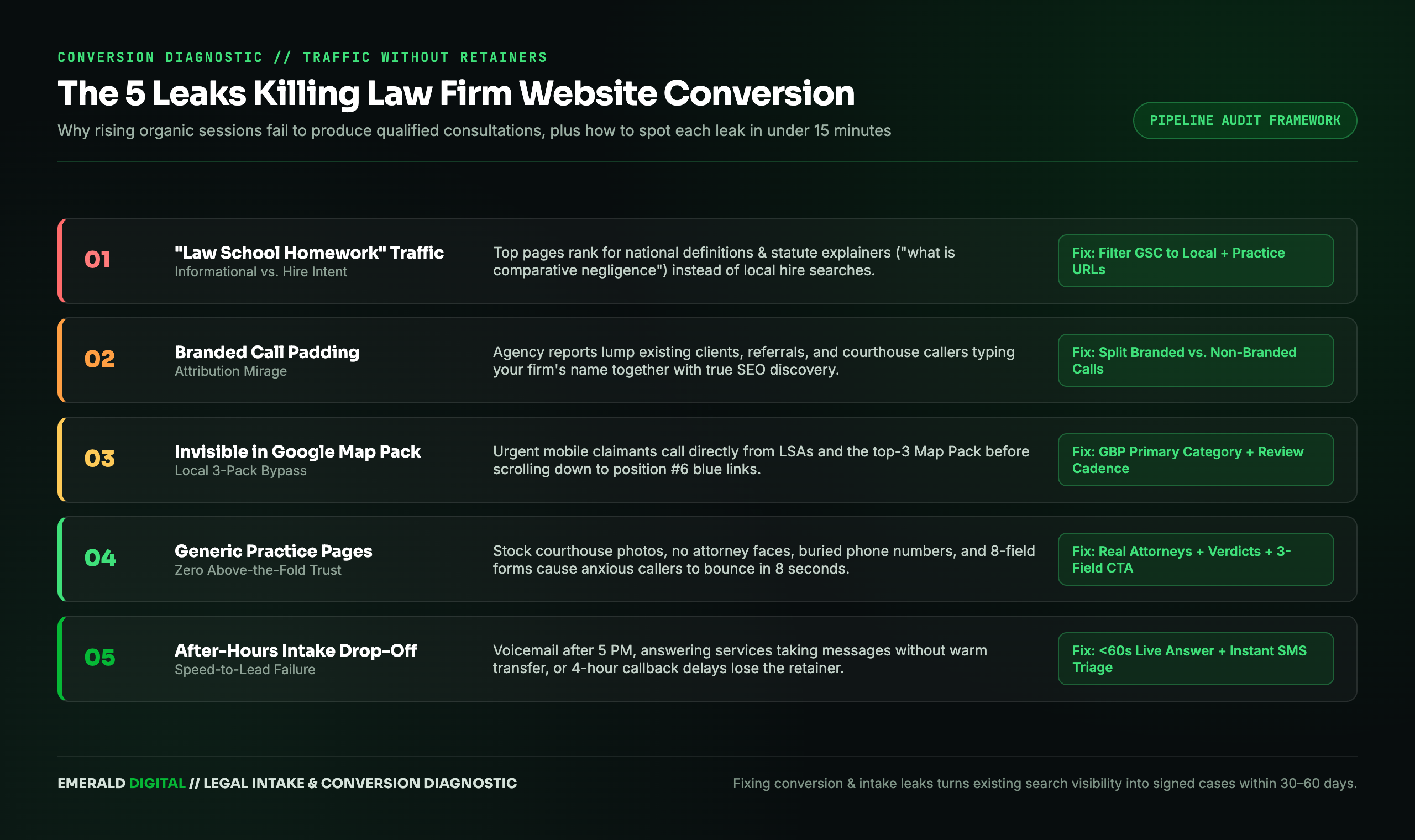
Leak #1: You're Ranking for "Law School Homework" Instead of Commercial Cases
The easiest way for an SEO agency to juice a traffic chart is to publish 50 blog posts answering nationwide informational questions:
- "What is the statute of limitations for negligence in Texas?"
- "What does comparative fault mean?"
- "Can you sue someone for emotional distress?"
- "How much is a rear-end settlement worth?"
Those articles rack up thousands of visits from paralegals, insurance adjusters, law students, and bored people in 48 states you aren't even licensed to practice in. None of them are hiring a lawyer today.
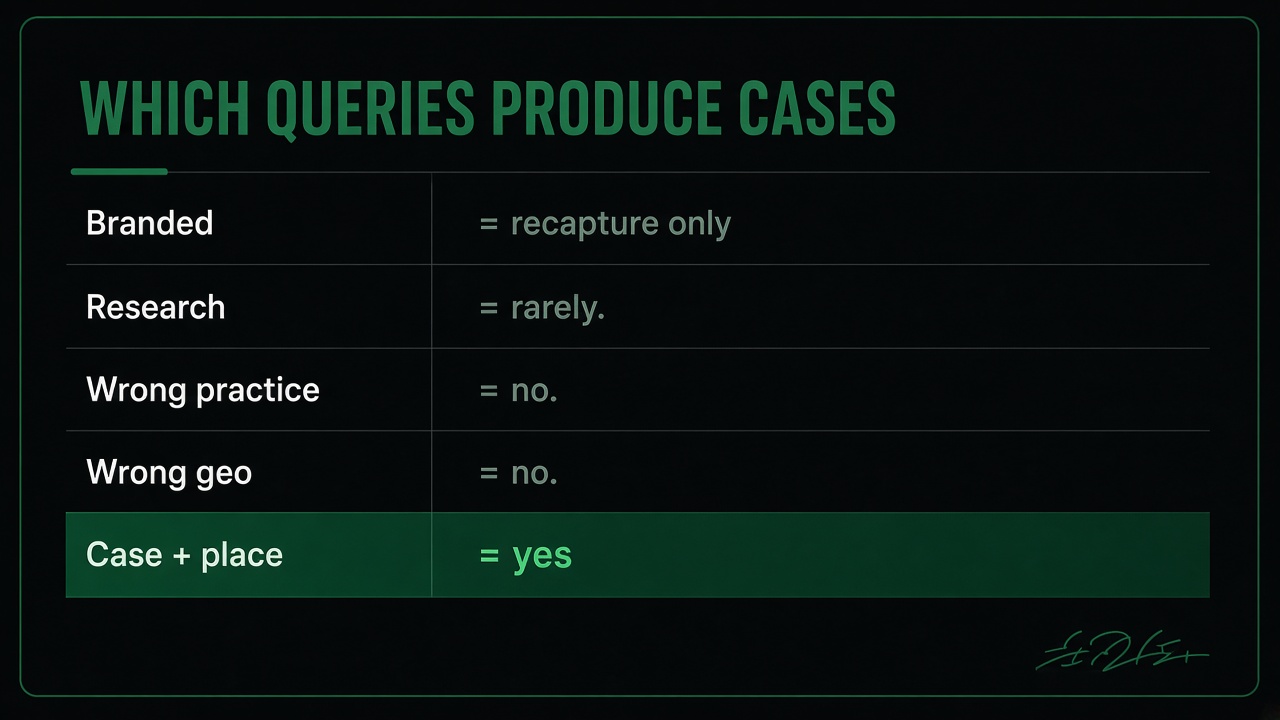
How to check it right now: Open Google Search Console, click Performance > Pages, and look at your top 10 pages by clicks over the last 90 days.
- If 80% of your organic traffic lands on
/blog/articles while your core practice pages (/car-accident-lawyer/,/truck-accident-lawyer/,/criminal-defense-attorney/) sit on page 3 with 12 clicks a month, you don't have a conversion problem. You have a traffic-intent fraud problem.
The fix: Stop paying for generic legal encyclopedia articles. Redirect your content and link budget into commercial practice-area pages, sub-practice pages (e.g., commercial 18-wheeler underride accidents, Rideshare/Uber injury claims, contested high-asset divorce), and local city hubs where the searcher actually needs counsel in your jurisdiction.
Leak #2: Your Agency Is Taking Credit for Your Own Firm Name (Branded Padding)
This is the oldest sleight of hand in legal SEO reporting.
A managing partner spends $20,000 a month on billboards, referrals, local TV, or networking. Prospects hear your name, type your firm's name into Google, click your homepage or Google Business Profile, and call the front desk. Worse, current clients call the main number every Tuesday to ask a paralegal for a status update on their file.
At the end of the month, your agency bundles every single one of those calls into a big number labeled "180 Organic SEO Leads."
How to check it right now:
- In Google Search Console, filter Queries to exclude your firm name and your partners' last names. Does your "organic growth" suddenly flatline? (If you are invisible whenever someone searches a practice area without typing your name, read our breakdown on why your firm only ranks for its own name.)
- Pull the last 30 call recordings from your SEO tracking numbers. Count how many are existing clients, vendors, opposing counsel, or referrals who already knew your name.
Leak #3: You're Invisible in the Google Local 3-Pack (Where the Calls Actually Happen)
When someone gets arrested for a DUI at 11:00 PM or gets T-boned at an intersection, they don't scroll down to organic result #7 on a desktop monitor to read a 2,500-word essay. They pull out an iPhone, search "car accident lawyer near me", and tap one of the top three firms in the Google Local Map Pack.
If your traditional blue-link rankings improved from position #9 to position #5, your impressions and traffic will rise, but the three firms sitting in the Local Pack above you are still eating 70% of the phone calls.
What wins the Local Pack in 2026:
- Primary & secondary GBP categories: Setting your primary category to Personal Injury Attorney instead of a generic Law Firm label when PI is your bread and butter.
- Review velocity and specificity: A firm getting 8 new reviews every month that naturally mention the practice area and city ("handled my motorcycle accident in New Orleans") will outrank a stagnant profile with 150 reviews from three years ago.
- Location landing page alignment: Linking your Google Business Profile to a fast, conversion-engineered office page with embedded local schema, real attorney photos, and driving directions.
Leak #4: Your Practice Pages Look Like a Bar Journal Instead of a High-Trust Intake Page
Suppose a high-value prospect does land on your practice-area page. Put yourself in their shoes. They are stressed, in pain, or facing criminal or financial jeopardy, and they are viewing your site on a 6-inch mobile screen.
What do they see on most law firm websites?
- A slow-loading stock photo of a gavel or the Lady Justice statue
- A 600-word wall of 14px gray text explaining the elements of duty, breach, and causation
- A generic "Contact Us" form buried at the very bottom of the page with 9 required fields
High-intent legal prospects need three things in the first 5 seconds on mobile:
- Immediate proof they are in the right place: Clear headline naming the exact case type and city, plus real photos of the actual trial lawyers who will handle their case.
- Hard proof you win: Specific verdict and settlement numbers, client video testimonials, and Google review ratings right above the fold.
- Frictionless ways to reach a human right now: Sticky tap-to-call button on mobile, a 3-field case evaluation prompt, or an intelligent intake chat that answers immediately.
Leak #5: The 5-Minute Intake Cliff (Where Paid-For Leads Go to Die)
Even when your SEO campaign delivers real, non-brand commercial prospects to your website, a shocking number of law firms lose the case in the 15 minutes after the form is submitted or the phone rings.
Look at the industry data: Hennessey Digital's multi-year National Law Firm Lead Form Response Time Studies have repeatedly audited hundreds of law firms across the country to see how fast they actually respond to a web lead. Year after year, a huge percentage of firms take hours, days, or fail to follow up altogether.
In consumer legal verticals (personal injury, criminal defense, family law, employment), the first reputable firm to get a live, empathetic human on the phone signs the retainer. If a prospect submits a form at 6:30 PM and your intake team calls them back at 9:45 AM the next morning, that prospect has already signed a DocuSign agreement with the firm down the street.
When we launched [The Law Center](/case-studies/the-law-center) (TheLawCenter.com) for a consortium of seven law firms across six states, we knew driving traffic wasn't enough. We had six months to take a brand-new domain from zero to profitable case volume. Alongside building 200+ geographic landing pages, 100+ medical-authority articles, and earning 7,000+ backlinks from 1.3 billion PR impressions, we built an AI qualification chatbot directly into the intake flow.
Instead of letting web visitors bounce off a static contact form, the AI intake system engaged claimants immediately, pre-screened case criteria 24/7, and routed qualified injury leads straight to human intake specialists. The result in six months:
- #2 nationally for "motorcycle accident lawyer" (18,000 searches/month)
- 5,800+ total contacts and 5,000+ qualified leads (30+ qualified leads/day sustained)
- 5x increase in signed cases
- 40% reduction in cost per acquisition (CPA)
The 90-Day Traffic-to-Signed-Cases Diagnostic Worksheet
Stop guessing where the leak is. Have your marketing director or agency fill out this exact two-part table comparing the last 90 days to the prior 90 days.
Part A: Google Search Console & GA4 Reality Check (Last 90 Days)
| Page Group | Organic Sessions | Non-Brand Share (%) | Tracked Calls + Forms | Qualified Consults | Signed Cases | The Verdict |
|---|---|---|---|---|---|---|
| 1. Homepage + Attorney Bios | [ ] | [ ]% | [ ] | [ ] | [ ] | Mostly brand & referral traffic; do not let your SEO agency claim this as "new SEO growth." |
| 2. Practice-Area & City Pages | [ ] | [ ]% | [ ] | [ ] | [ ] | This is your real SEO engine. If sessions here are flat, your SEO isn't working. If sessions are high but calls are <2%, your page UX/conversion is broken. |
| 3. Blog / Informational Posts | [ ] | [ ]% | [ ] | [ ] | [ ] | If this row has 75%+ of your traffic and 0 signed cases, you are paying for out-of-state law school homework. |
| 4. Google Business Profile (GBP) | [ ] | [ ]% | [ ] | [ ] | [ ] | Filter out existing client calls. If new non-brand calls are low, you are losing the Local 3-Pack. |
Part B: Intake Speed & Conversion Cohort Check (Sample Last 50 Non-Brand Leads)
| Lead Channel | Total Raw Leads | Answered Live (<2 Min) | Reached in <5 Min | Qualified Case Fit (%) | Signed Retainers | Exact Bottleneck |
|---|---|---|---|---|---|---|
| Organic Practice Pages (Calls) | [ ] | [ ]% | [ ]% | [ ]% | [ ] | If live answer rate is under 85%, fix call routing and after-hours coverage before spending another dollar on SEO. |
| Organic Practice Pages (Forms/Chat) | [ ] | N/A | [ ]% | [ ]% | [ ] | If speed-to-lead is over 5 minutes, leads are signing with a faster competitor before your team dials. |
| Google Business Profile Calls | [ ] | [ ]% | [ ]% | [ ]% | [ ] | High volume + low qualification usually means wrong secondary GBP categories or missing negative screening. |
How to Fix It Without Starting Over
If you run that diagnostic and realize you're paying $5,000 to $15,000 a month for vanity traffic, you don't necessarily have to burn your website to the ground:
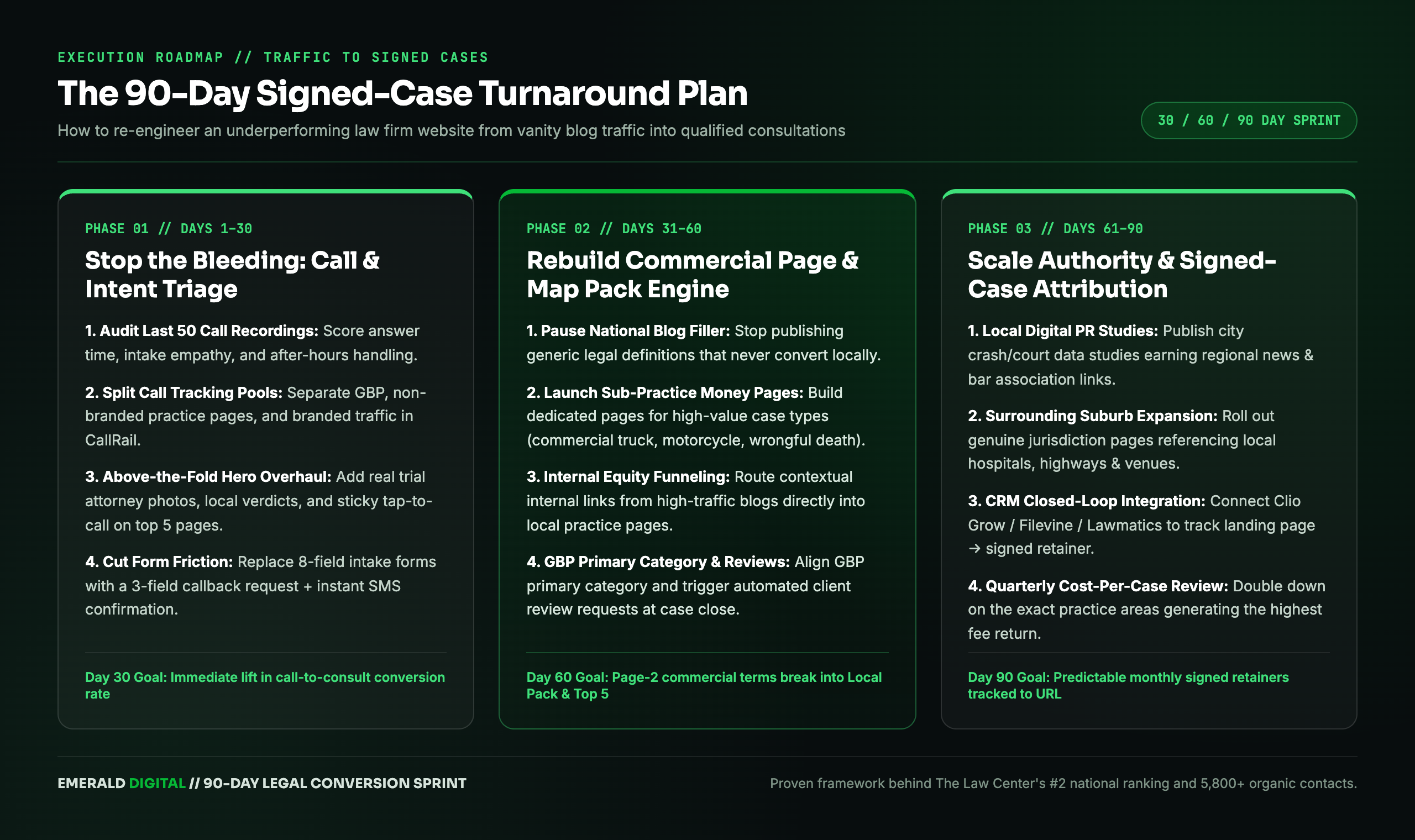
- Freeze all generic blog production today. Reallocate 100% of your content and link budget to money pages: core practice areas, high-value sub-practices, and local jurisdiction pages. (See our breakdown of what law firm SEO should actually cost to see how deliverables should be weighted.)
- Rebuild the top 20% of pages driving 80% of commercial impressions. Add above-the-fold verdict proof, real attorney video/photos, sticky mobile tap-to-call, and instant intake pre-qualification.
- Separate brand from non-brand reporting forever. Demand a monthly dashboard that shows non-brand commercial clicks, qualified new-client calls, and signed retainers by landing page.
If you're tired of getting gaslit by green traffic charts while your caseload stays flat, check out our Law Firm SEO & Growth Programs or book a diagnostic call with us. Bring your Search Console and your last three agency reports. We'll show you where the cases are leaking in 20 minutes flat.