

If your law firm ranks number one for its own name and sits on page three for the cases that actually pay the partners, you do not have an SEO program yet. You have a digital business card.
Branded traffic feels comforting in a monthly report because the click-through rate is high and the conversion rate looks healthy. Of course it does. Referrals, repeat clients, and people who already heard your name from another attorney are typing your firm straight into Google to find your phone number. They were already going to call you.
Real organic growth happens when an injured driver, a business owner in a contract dispute, or a spouse filing for divorce searches for the legal problem in your city without knowing who you are, and lands on your firm first. Otherwise, you end up wondering why your law firm website gets traffic and zero signed cases.
Here is why Google currently treats your website as a firm-name directory entry instead of a practice-area authority, and the exact rebuild sequence we use to fix it.
Why Google Only Trusts You for Your Firm Name
When a law firm ranks for its name and nothing else, the problem is almost never a secret technical penalty. It comes down to four structural mistakes we see in almost every legal SEO audit we run.
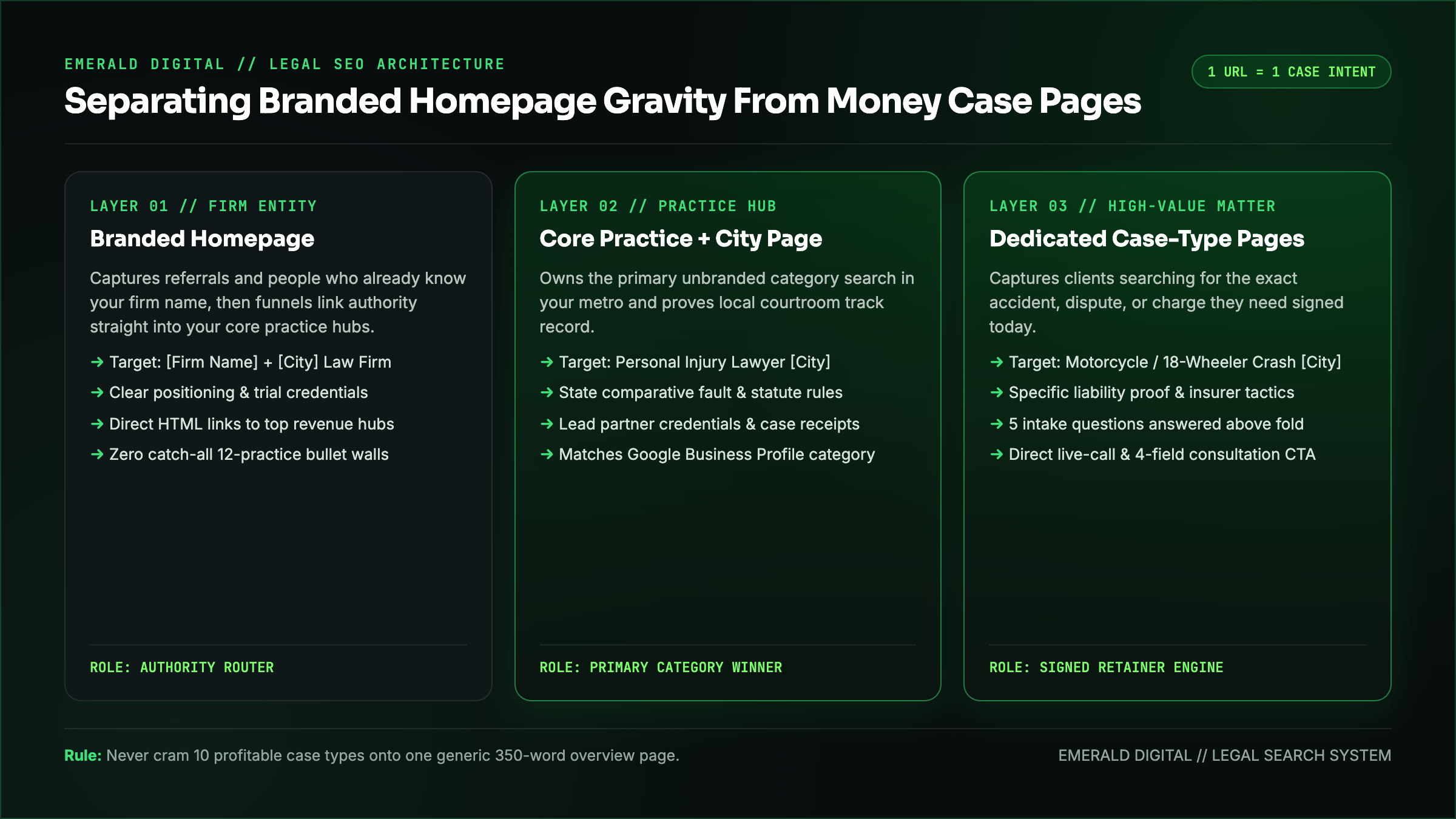
- Every strong signal points at the homepage. Your homepage carries your firm name in the title tag, absorbs nearly every backlink from your bar profile, local chamber, and sponsorships, and lists ten practice areas in a single bulleted grid. Google reads that and concludes your site is about your firm name, not any specific type of case.
- Your practice area pages are thin brochures. A 350-word "Personal Injury" or "Family Law" overview page that says your attorneys "fight tirelessly for clients" looks identical to fifty other law firm websites in your metro. It gives a search engine zero reason to rank you ahead of an entrenched competitor.
- You bundle distinct cases onto one catch-all URL. Clients rarely hire a generic "personal injury lawyer" when their specific problem is an 18-wheeler wreck, a motorcycle crash, or a wrongful death claim. When you cram twelve case types onto one page, you lose to the firm that built a dedicated, authoritative page for the exact case on the table.
- Your internal links and anchor text are generic. Linking from your homepage or blog with anchor text like "Read more" or "Our services" wastes the authority your domain already has.
Next step
Build search visibility around the cases you want.
See how we rank law firms for the cases that payStep 1: Split Branded and Non-Branded Search Console Data Today
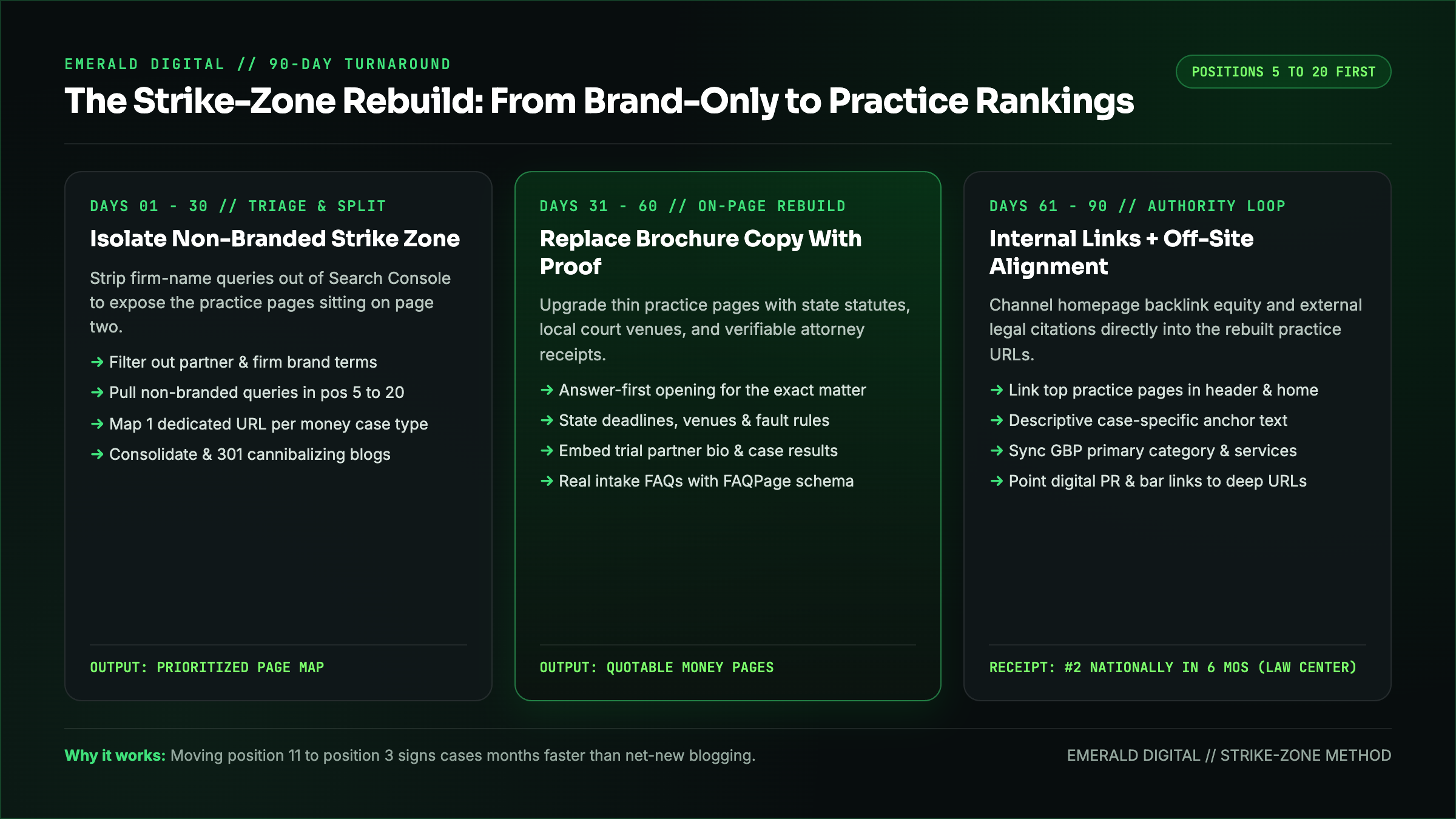
Before you rewrite a single headline, strip your firm name out of your reporting so you can see where your real baseline sits.
Open Google Search Console, go to Performance > Search results, and add a query filter that excludes your firm name, partner last names, and common misspellings. What remains is your true commercial visibility.
Sort the remaining non-branded queries by impressions and filter for average positions 5 through 20. We call this the Strike Zone. These are high-intent practice-area searches where Google already considers your site relevant enough to index on page one or page two, but your page has not earned the top three spots where the phone calls happen. Moving a page from position 11 to position 3 for `truck accident lawyer [city]` or `probate litigation attorney [city]` produces signed cases months faster than publishing fifty top-of-funnel blog posts from scratch.
Step 2: Give Every Money Case Its Own Dedicated Page
One page can only win one primary search intent. If a case type is profitable enough that you want five more of them this quarter, it needs its own dedicated URL with its own title tag, H1, jurisdictional proof, and intake path.
| Page Type | What Job It Does | Example Target Search | What Belongs on the Page |
|---|---|---|---|
| :--- | :--- | :--- | :--- |
| Homepage | Confirms who you are, where you practice, and routes visitors to your core practice hubs | `[Firm Name]`, `[City] law firm` | Clear positioning, primary office locations, top verdicts or case results, direct links to core practice hubs |
| Core Practice Hub | Owns the primary practice category in your market | `personal injury lawyer [city]`, `criminal defense attorney [city]` | Who you represent, how cases work in your local courts, lead attorney credentials, links to specific case-type pages |
| Case-Type Money Page | Wins the specific high-value matter the client is searching for | `motorcycle accident lawyer [city]`, `commercial lease dispute lawyer [city]` | Fault and liability rules in your state, what damages or outcomes are realistic, relevant case results, specific FAQs, direct consultation CTA |
| Suburb or Venue Page | Captures surrounding cities where you actually practice and appear in court | `car accident lawyer [suburb]` | Local court venue context, driving directions or service area proof, cases handled in that parish or county |
Do not spin up thirty near-duplicate city pages where you only swap the town name in the H1. Only build a page when you can put real legal substance, state or local court procedure, and genuine firm proof on the screen.
Step 3: Put Operator Proof Where Boilerplate Copy Used to Be
Most law firm practice pages fail because they are written by generalist copywriters summarizing other law firm websites. They spend the first 400 words explaining that car accidents are stressful before ever mentioning your firm.
A prospective client and a search engine both want proof that you actually handle this specific matter in this specific jurisdiction:
- Open with the case, the jurisdiction, and the stakes. State clearly in the first paragraph what type of case you handle, where you practice, and what a client needs to protect in the first 48 hours.
- Name the statutes, courts, and timelines that govern the case. Reference your state's comparative fault rule, filing deadlines, local court divisions, or insurer tactics by name. Specific jurisdictional detail is a signal generic content farms rarely fake well.
- Attach real attorney credentials and case receipts. Put the lead trial attorney's bar admissions, courtroom background, and representative case results directly on the practice page instead of hiding them three clicks away on a bio page.
- Answer the five questions intake hears on every phone call. What does it cost to hire you? Who pays medical bills while a claim is pending? When should I refuse a recorded statement? What makes a strong case versus a weak one? How long does a case like this take in our county?
When we took The Law Center from a brand-new domain with zero organic presence to #2 nationally for "motorcycle accident lawyer" in six months, we did not do it by padding their homepage with brand slogans. We built focused commercial practice pages backed by disciplined link acquisition and technical structure, generating 5,800+ contacts, 30+ qualified leads per day, and a 5x increase in signed cases.
Step 4: Route Internal Authority From Your Homepage and Blog to Your Money Pages
Because your homepage and older articles usually hold most of your domain's backlink equity, you have to deliberately channel that authority into the practice pages you want to rank.
- Link your top revenue practice pages directly in your primary navigation and homepage body. Every click depth away from the homepage reduces how frequently crawlers and users reach the page.
- Use descriptive, natural anchor text. Replace vague links like "Learn more about our services" with specific phrasing like "speak with our New Orleans commercial litigation attorneys" or "see how we handle disputed motorcycle injury claims."
- Connect supporting pain-query articles back to the exact practice page. If you publish an article answering what happens after an uninsured driver crash in your state, link it directly to your uninsured motorist and car accident practice pages, and link those practice pages back out to your strongest supporting guides.
- Consolidate cannibalizing blog posts. If you have four old 400-word blog posts competing with your main truck accident page for the same query, merge the useful details into the main practice page and 301-redirect the dead weight.
Step 5: Align Your Google Business Profile and Off-Site Citations With Your Practice Areas
Your website does not rank in a vacuum. Google cross-checks your practice pages against your Google Business Profile, your state bar listing, Avvo, Justia, Super Lawyers, FindLaw, and local press mentions.
- Set your Google Business Profile primary category to the exact practice area that drives the majority of your revenue (for example, `Personal injury attorney` or `Divorce lawyer` rather than generic `Law firm`), and add your secondary practice categories underneath.
- Build out the Services section inside your Google Business Profile so every core case type on your website has a matching service entry.
- When you earn local press quotes, legal commentary placements, or bar association links, point a portion of those links and brand mentions directly to the relevant practice area page rather than sending 100% of links to your root domain.
Want Us to Map the Practice Searches Your Firm Should Own?
If you are tired of paying an agency to report on people who were already typing your firm name into Google, bring us your domain. Our focused legal SEO programs start at $3,500/month for scoped single-market builds, with competitive multi-practice campaigns typically running $5,000 to $10,000/month.
See how we build compounding search programs on our law firm SEO page, or request a free SEO teardown and we will show you your non-branded rankings versus your top local competitors, the Strike Zone practice pages sitting on page two, and the exact rebuild order to turn them into signed cases.