When someone gets T-boned at an intersection or arrested on a Saturday night, they aren't reading a 3,000-word blog post about comparative negligence. They pull out their phone, type `car accident lawyer near me` or `criminal defense attorney [city]`, and tap one of the three firms inside the Google Map Pack.
Here is the dirty secret of legal marketing: big firms with $100,000/month billboard budgets lose the Map Pack all the time.
They lose it because they treat their Google Business Profile like a static Yellow Pages listing from 2014. Meanwhile, a hungry 3-to-15 lawyer firm that treats its profile like a primary revenue channel can lock down the top three slots in its backyard and take cases right out from under the giants.
Why the Map Pack plays by different rules than organic search
Traditional organic rankings reward domain authority, backlinks, and deep practice-area pages. That is where we took The Law Center to #2 nationally for "motorcycle accident lawyer" in six months, driving 5,800+ inbound contacts.
The Google Map Pack runs on a different algorithm with three levers: Relevance, Distance, and Prominence.
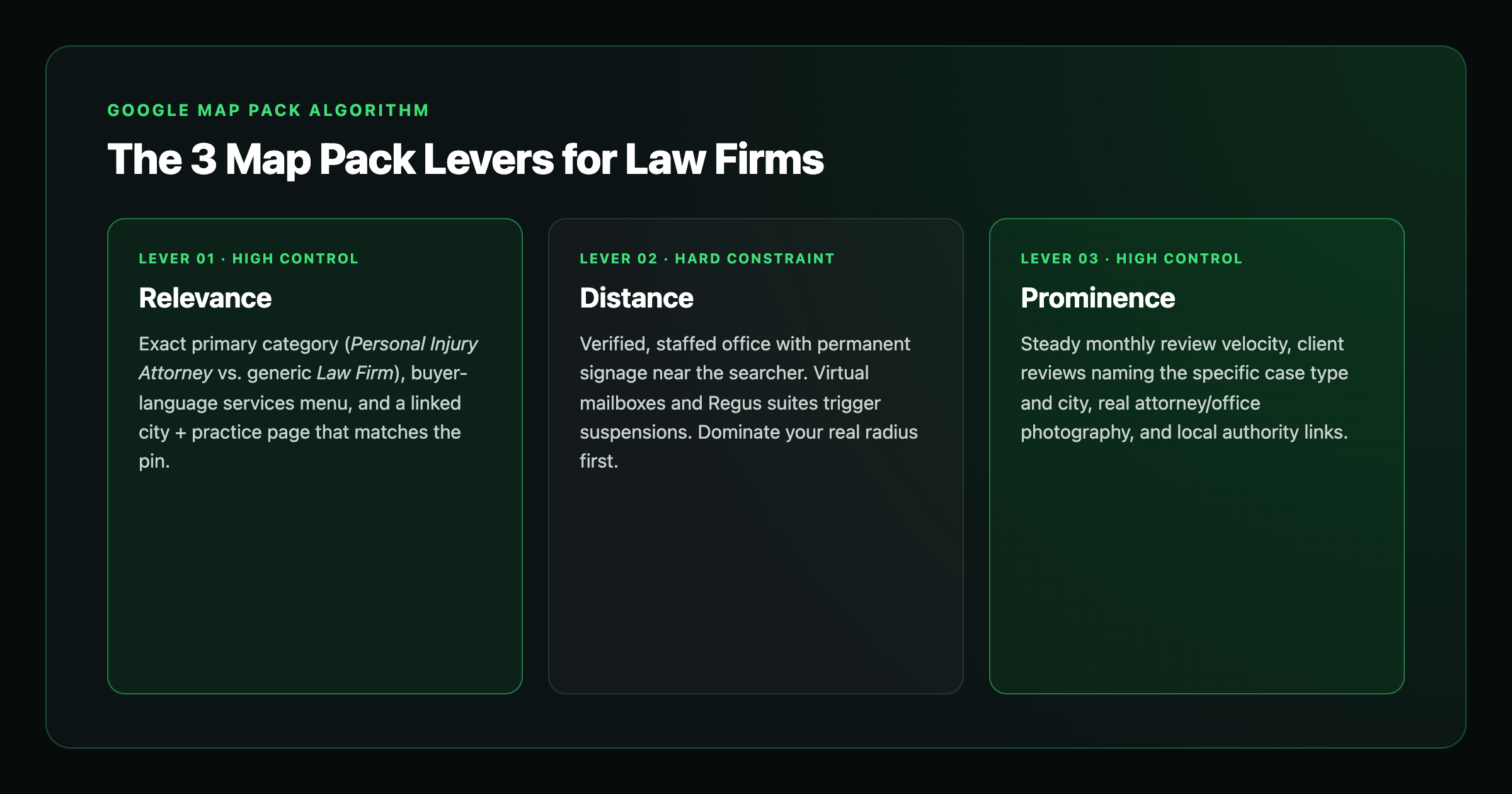
| Map Pack lever | What Google actually checks | Can a smaller firm win it? |
|---|---|---|
| Relevance | Does your primary category, service list, and linked website page match the exact legal matter the client searched? | Yes. Most big firms botch this by picking a broad "Law Firm" category. |
| Distance | How physically close is your verified, staffed office to the person holding the phone? | Within your radius. You can't fake proximity without risking suspension, so you win your radius first. |
| Prominence | Review volume, review velocity, keywords inside client reviews, local links, and real listing activity. | Yes. Consistent post-case review requests beat a lazy 80-lawyer firm every time. |
Before you touch a category or order another batch of city pages, run this diagnostic to see where you are actually losing cases right now:
| What you see in the wild | What is actually broken | What we fix first |
|---|---|---|
| Invisible inside your own zip code | Wrong primary category (`Law Firm` instead of `Personal Injury Attorney`), duplicate listings, or stagnant reviews | Set the highest-value primary category, merge/suppress duplicates, and launch a weekly review cadence with closed clients |
| Top 3 on your block, invisible 3 miles away | Proximity ceiling combined with a weak landing page linked from the pin | Point the profile URL to a dedicated city + practice page and build local authority and matter-specific reviews |
| High Map Pack views, almost no phone calls | You're sitting next to a competitor with 240 fresh reviews while you have 19 from 2022 and a stock gavel photo | Overhaul real attorney/office photos, respond to every review, and systematize review requests at case resolution |
| Map Pack calls are up, signed retainers are flat | Your Map Pack phone number routes into an automated phone tree, voicemail, or slow front desk | Route a dedicated Map Pack tracking line to live 24/7 intake and audit every recorded call over 60 seconds |
When we audit a firm's local pipeline, we track the entire chain: exact search query, searcher radius, which profile showed up, which page the pin points to, who answered the phone, and whether that caller signed a fee agreement.
Next step
Build search visibility around the cases you want.
See how we rank law firms for the cases that payHow big law firms hand you the 3-pack
If you pull up the Google Business Profiles of the biggest firms in your city, you will see the same unforced errors over and over:
- Lazy category selection. They set `Law Firm` or `Legal Services` as their primary category because they have six practice groups arguing over the listing. If you are a personal injury firm and your primary category is `Personal Injury Attorney`, you immediately have a relevance edge for injury searches.
- Dead review velocity. They got 90 reviews three years ago during a one-time push and haven't asked a client since. Google rewards recency. Five real reviews a month beats a dusty pile from 2021.
- Stock photos and corporate sterile lobbies. People hiring a lawyer want to see the actual human beings who will represent them and the building they are driving to.
- Broken intake handoffs. The phone number on the profile rings a receptionist who puts an injured caller on hold for four minutes. That caller hangs up and taps the second firm in the pack.
- Orphaned homepage links. The profile links to a generic national homepage that barely mentions the local city or specific case types.
You don't need a seven-figure ad budget to beat that. You just have to execute the fundamentals they ignore.
How to dial in your Google Business Profile this week
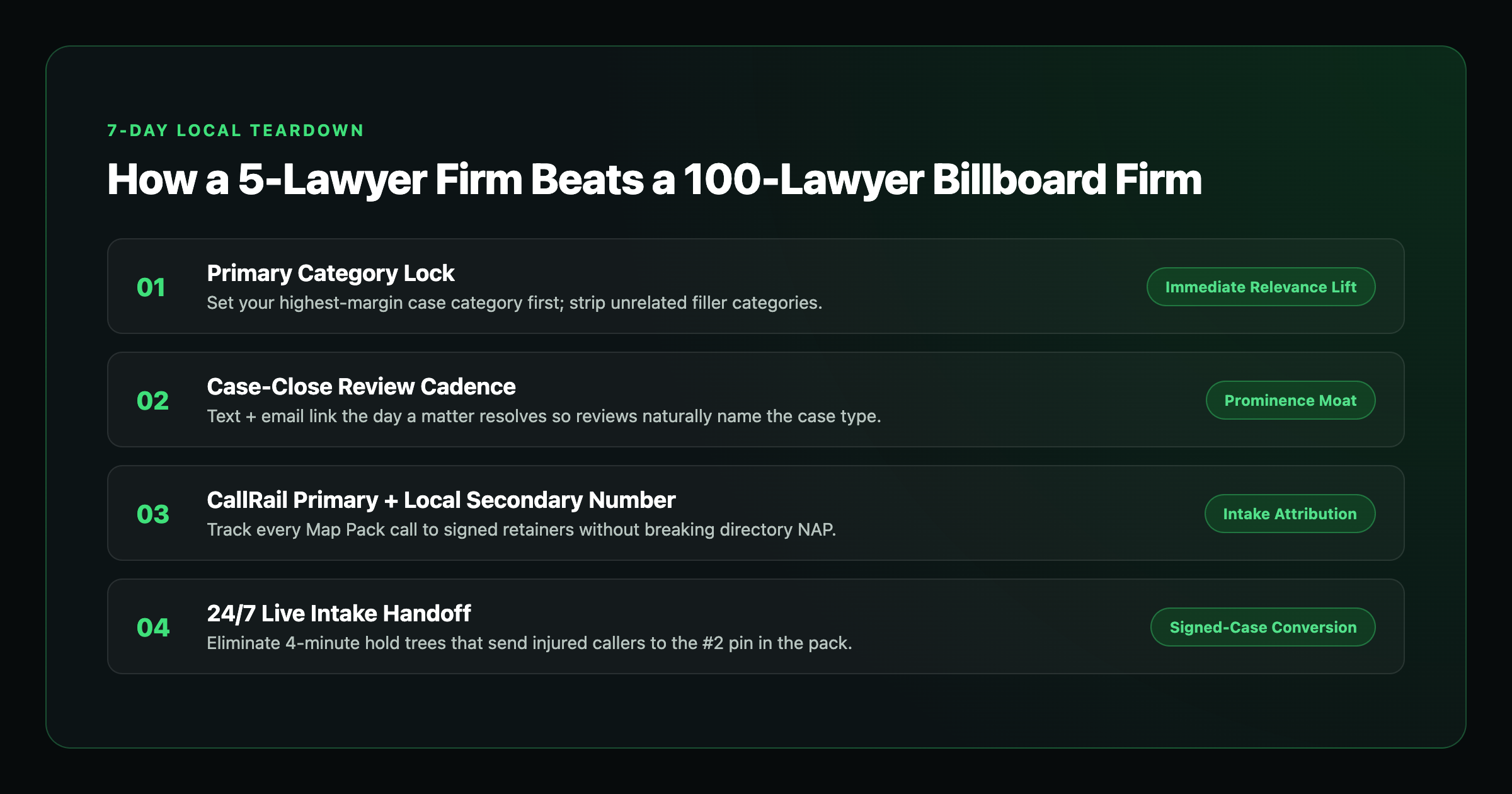
If you want your firm moving toward the 3-pack, stop treating the profile like a directory card and configure it like a landing page:
- Nail the primary category. Pick the single category that drives your highest-margin cases (`Personal Injury Attorney`, `Criminal Justice Attorney`, `Divorce Lawyer`, `Estate Planning Attorney`). Add only the secondary categories you genuinely practice. Stuffing ten unrelated categories dilutes your relevance.
- Build out the services menu using buyer language. Don't just list "Torts." List `Car Accident Lawyer`, `Commercial Truck Wreck Representation`, `Motorcycle Accident Claims`, and `Wrongful Death Litigation`.
- Replace stock art with real photography. Upload sharp photos of your exterior signage (which also helps prevent Google verification suspensions), your conference room, and your attorneys working.
- Use a dedicated call-tracking number as the Primary Phone, and keep your main local number as Secondary. That lets you record and score every Map Pack call in CallRail without breaking your NAP (Name, Address, Phone) consistency across legal directories.
- Link to a page that matches the pin. If you are a single-location firm, your homepage or primary practice hub must prominently establish your city, jurisdiction, and core case types above the fold. If you have multiple offices, each pin must link to its own dedicated location page.
Reviews are the prominence lever you control
You cannot buy 20 years of domain age overnight, and you cannot move your office building closer to every intersection in town. What you can control is review velocity.
Build the ask into your case wrap-up workflow. The day a settlement check clears or a charge gets dismissed, the client is as grateful as they will ever be. Send them a direct text and email link to your Google review form while they are still smiling.
You never want to script fake reviews or violate bar ethics rules, and you don't need to. When a happy client naturally mentions what you did ("helped me after my motorcycle crash on I-10"), Google highlights those exact words in bold inside the Map Pack results. That moves both your ranking and your click-through rate.
Respond to every single review. Thank the five-star clients without disclosing confidential case details, and stay calm and professional if a non-client leaves a one-star rant. Prospective clients read your responses to see how you behave under pressure.
Distance is a hard constraint. Don't play the fake-office game.
Every year, an agency convinces a law firm to rent five $150/month virtual offices or coworking mailboxes around the metro area so they can spin up five Google Business Profiles.
And every year, competitors report those pins, Google suspends the entire account, and the firm loses its real primary listing right in the middle of peak season.
Google's rules are black and white:
- Staffed office addresses require permanent exterior/suite signage and real firm staff present during stated business hours to meet clients.
- Individual practitioner profiles are allowed for multi-attorney firms when an attorney is genuinely public-facing at a verified office, but solo practitioners do not get two pins for one lawyer.
If you have one real office, own the 3-pack in your real radius. Then build high-converting practice-area and suburb pages to rank organically in the surrounding towns where your Map Pack pin won't reach. If you open a second legitimate, staffed office, build a second profile the right way.
Why Map Pack ownership is the ultimate escape from $150 PPC clicks
Google Local Services Ads (LSAs) and search ads can buy your way to the top of the screen tomorrow morning, and we run paid acquisition for firms that want immediate volume. But legal Google Ads clicks routinely run $50 to $150+, and the moment you pause the credit card, the phone stops ringing.
The Map Pack doesn't send you a per-click invoice. Once you earn a top-three spot and back it up with a real review moat, you capture high-intent local callers every week without paying a lead reseller or fighting a daily bidding war.
And make sure your website doesn't waste the traffic once they tap through. If your profile sends callers to a slow, generic site that doesn't convert, you have the exact same problem as law firms with website traffic and no signed cases.
Want to see who owns the Map Pack in your market and why?
Our legal SEO engagements start at $3,500/month for focused local and Map Pack scopes, with competitive multi-practice metro builds typically running $5,000 to $10,000/month.
Before you spend a dollar, request a free law firm SEO teardown. We will pull the live Map Pack grid around your office, show you why the top three firms are sitting above you right now, and give you the exact roadmap to take their spot.
---
FAQ
How do I get my law firm into the Google Map Pack?
Lock down the right primary category (like Personal Injury Attorney instead of generic Law Firm), tie the pin to a page on your site built for that exact practice and city, earn steady reviews that mention the actual case type, and run a real staffed office. Google scores relevance, distance, and prominence. You cannot fake distance, so you win by crushing relevance and prominence.
Can a small law firm actually beat a 100-lawyer firm on Google Maps?
All day long. Huge billboard firms treat their Google Business Profile like an intern chore. They leave 'Law Firm' as their primary category, let reviews sit unanswered for months, and route the map phone number to a generic call-center tree. A four-lawyer firm with a dialed-in profile, steady matter-specific reviews, and live intake will beat them inside its radius.
Do Google reviews actually help law firm SEO rankings?
Yes, both for ranking in the 3-pack and for getting the caller to tap your number instead of the firm above you. Review count, recency, and what the client actually writes all move the needle. A review that says 'handled my rear-end truck accident in Metairie' is worth ten generic five-star clicks.
Should I open extra Google Business Profiles to rank in neighboring suburbs?
Only if you have a real, staffed office with permanent signage where clients actually meet your team. Renting a $99 Regus mailbox or coworking desk to drop pins across a metro is the fastest way to get your entire Google Business Profile suspended. Dominate the Map Pack around your real office, and use organic city + practice pages to win the surrounding suburbs.
Is the Google Map Pack more important than organic rankings for lawyers?
For 'near me' and city-plus-lawyer searches, the Map Pack sits right above the organic blue links and takes the lion's share of direct phone taps. But you still need both: strong organic practice pages help power your Map Pack relevance, and they capture the high-value searches outside your immediate 5-mile office radius.